SSF vs Provident Fund: which one actually leaves you better off?
SSF takes 11% of your basic salary and PF takes 10%, so SSF looks more expensive on the payslip. Priced properly — tax waived, employer contribution, what you own at the end — the comparison usually runs the other way.
Updated 7 min readWritten for FY 2083/84
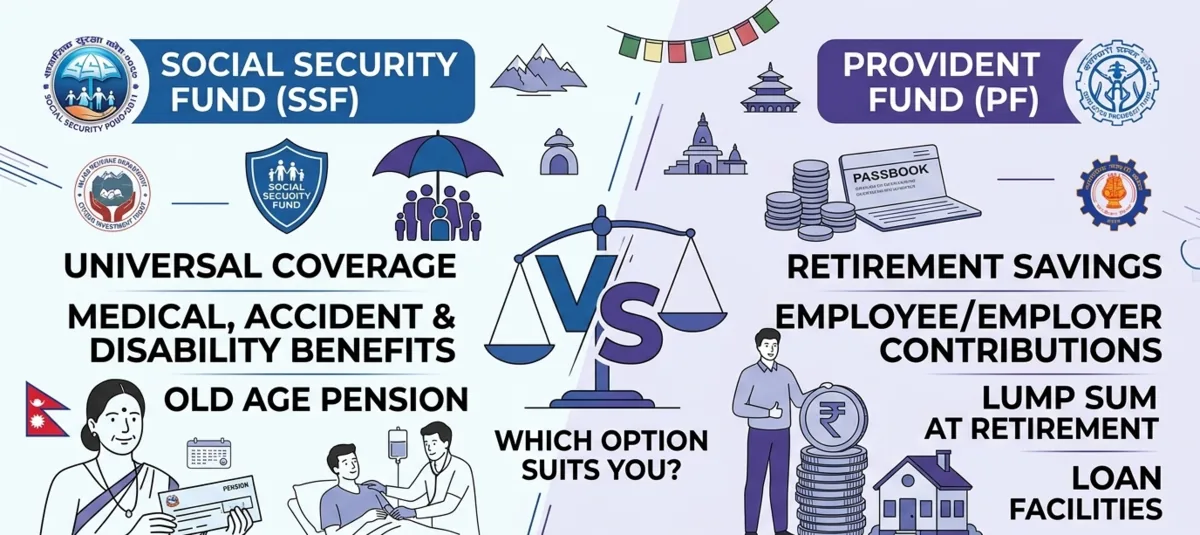
Short answerSSF costs 11% of basic against PF's 10%, but SSF members skip the 1% Social Security Tax band and the employer puts in 20% instead of 10%. At NPR 1,00,000 a month with basic at 60%, SSF means NPR 10,720 less tax and NPR 72,000 more in your own fund each year than PF.
The comparison, in numbers
Take NPR 1,00,000 a month with basic salary at 60% of gross — the split most Nepali employers use. SSF here is the Social Security Fund (Samajik Suraksha Kosh); PF is the Employees Provident Fund (Karmachari Sanchaya Kosh). Under PF the annual tax is NPR 22,800. Under SSF it is NPR 12,080, because the 1% Social Security Tax band is waived. Your own fund grows by NPR 2,23,200 a year under SSF against NPR 1,44,000 under PF.
| What’s compared | No fund | Provident Fund | SSF |
|---|---|---|---|
| You contribute (year) | 0 | 72,000 | 79,200 |
| Employer contributes (year) | 0 | 72,000 | 1,44,000 |
| Income tax for the year | 30,000 | 22,800 | 12,080 |
| Cash reaching your account | 11,70,000 | 11,05,200 | 11,08,720 |
| Added to your own fund | 0 | 1,44,000 | 2,23,200 |
| Cost to the employer | 12,00,000 | 12,72,000 | 13,44,000 |
Cash in hand is lowest under SSF — that is the 11% leaving the payslip. But the money did not disappear: it moved into a balance with your name on it, and it brought a bigger employer contribution with it. Comparing take-home alone is the mistake that makes SSF look expensive.
Why does SSF usually win?
Three effects stack: the 1% Social Security Tax band is waived for SSF members, the employer contributes 20% of basic instead of 10%, and the contribution buys medical, accident, dependant and old-age pension cover that a provident fund does not provide.
- The 1% band goes away. The Social Security Tax on the first NPR 10,00,000 is not charged to SSF contributors, because the SSF contribution discharges the same obligation. Worth up to NPR 10,000 a year.
- The employer puts in twice as much.20% of basic against PF's 10% — NPR 72,000 more a year in this example, and it is money you own, not the employer.
- It is insurance, not only savings. The 20% is split across pension, gratuity and the medical, accident and dependant schemes. A provident fund balance pays nothing if you are injured or ill.
The employer contribution is taxable and deductible at the same time
What do you give up by being on SSF?
SSF takes one more percent of basic salary out of every payslip, and the pension side of it is designed to be locked until retirement rather than withdrawn for a house or a wedding. If you need liquidity in the next few years, that is a real cost, not a technicality.
- Less cash today. 11% instead of 10% of basic — about NPR 7,200 a year at this salary.
- Withdrawal is tighter. SSF benefits are paid on the terms of each scheme; a provident fund balance has long been treated as more reachable for loans and partial withdrawal.
- Contributions follow the employer, not you. If you move to an employer outside the scheme, contributions stop — the balance stays, but the cover pauses.
What happens once you hit the NPR 5,00,000 ceiling?
Relief for PF, SSF and CIT together is capped at NPR 5,00,000 a year, or one-third of assessable income, whichever is lower. Once your own and your employer's contributions reach that ceiling, extra contribution stops reducing tax — and any employer contribution above it is taxed as income without a matching deduction.
At 31% of basic salary, an SSF member hits NPR 5,00,000 of combined contribution at roughly NPR 1,34,000 of basic salary a month. Above that, adding CIT on top saves nothing, and the calculator will show the relief line capped with the rule that capped it. The calculator prices this automatically; the guide explains the order the ceilings apply in.
| Combined relief ceilingPF + SSF + CIT together | NPR 5,00,000 |
|---|---|
| Or one-third of assessable income | whichever is lower |
| SSF total contribution rate11% you + 20% employer | 31% of basic |
| Basic salary that reaches the ceiling | ≈ NPR 1,34,000 / month |
Can you choose SSF for yourself?
Enrolment in the Social Security Fund is the employer's registration, not an individual election. Employers of ten or more workers are required to register; smaller employers and the self-employed may join voluntarily. An employee cannot switch from PF to SSF on their own.
What you can do is ask. If your employer runs PF only, the difference in this post is a concrete case to put to HR: the same basic salary, more employer contribution, less tax, and cover the company would otherwise buy as group insurance. If they are already registered, check that your basic salary on the SSF statement matches the one on your payslip — a mismatched base quietly shrinks both the contribution and the relief.
How do you check your own payslip?
Find the basic salary line, multiply by 11% (SSF) or 10% (PF) and compare it with the deduction shown. Then find the employer contribution line — it should be 20% or 10% of the same base. If the 1% Social Security Tax still appears on an SSF payslip, that is an error worth raising.
- Locate basic salary, not gross. Both funds are computed on basic.
- Check your deduction: 11% of basic for SSF, 10% for PF.
- Check the employer line: 20% for SSF, 10% for PF.
- Check the tax line against the calculator with the same fund selected — a persistent gap across months is worth a conversation with payroll.
Questions people ask
Is SSF better than Provident Fund in Nepal?
For most salaried employees, yes. SSF members skip the 1% Social Security Tax band, the employer contributes 20% of basic salary instead of 10%, and the contribution buys medical, accident, dependant and pension cover. PF is a savings balance only, with no insurance attached.
How much is deducted from my salary for SSF?
11% of basic salary from you, and 20% of basic salary from your employer — 31% in total. Provident Fund is 10% plus 10%. Both are calculated on basic salary, not on gross pay, unless your employer defines basic as the whole salary.
Does the employer's SSF contribution get taxed as my income?
The employer's SSF contribution is added to your assessable income and then deducted again as retirement relief, so under the NPR 5,00,000 combined ceiling the two cancel out and you pay no tax on it. Above that ceiling the excess stays in your income and is taxed.
Can I contribute to both SSF and Provident Fund?
In practice employers run one or the other, and an employer registered with the Social Security Fund is not required to maintain a separate provident fund or gratuity scheme. Whatever the mix, the relief for all retirement contributions shares a single NPR 5,00,000 ceiling.
Sources
The law, not a summary of a summary. Where a number is disputed between sources, the statute wins.
- Social Security Fund (Samajik Suraksha Kosh)
Official contribution rates, scheme rules and the employer registration process.
- Income Tax Act 2058 — Inland Revenue Department
Section 63 and Schedule 1: approved retirement funds, the relief ceiling and the Social Security Tax band.
- Employees Provident Fund (Karmachari Sanchaya Kosh)
The 10% + 10% scheme, balance statements and withdrawal rules.
Put your own salary through it
Every figure in this post comes from the same engine that runs the calculator. Enter your monthly salary and see your own TDS, take-home and slab-by-slab working — free, and nothing leaves your browser.
Keep reading
Tax slabs
Nepal's new tax slabs for FY 2083/84: what changed, and what it saves you
FY 2083/84 replaced Nepal's six salary tax bands with five, doubled the 1% band to NPR 10,00,000, cut the top rate from 39% to 29% and deleted the married schedule. Here is what each change does to a real payslip.
Offers & negotiation
Gross, CTC and take-home: how to read a Nepali offer letter
A CTC figure includes money that never reaches your bank account. A gross figure ignores the fund your employer pays into. Here is how to convert any Nepali offer into the two numbers that matter — cash in hand, and what you actually own.