Nepal's new tax slabs for FY 2083/84: what changed, and what it saves you
FY 2083/84 replaced Nepal's six salary tax bands with five, doubled the 1% band to NPR 10,00,000, cut the top rate from 39% to 29% and deleted the married schedule. Here is what each change does to a real payslip.
Updated 6 min readWritten for FY 2083/84
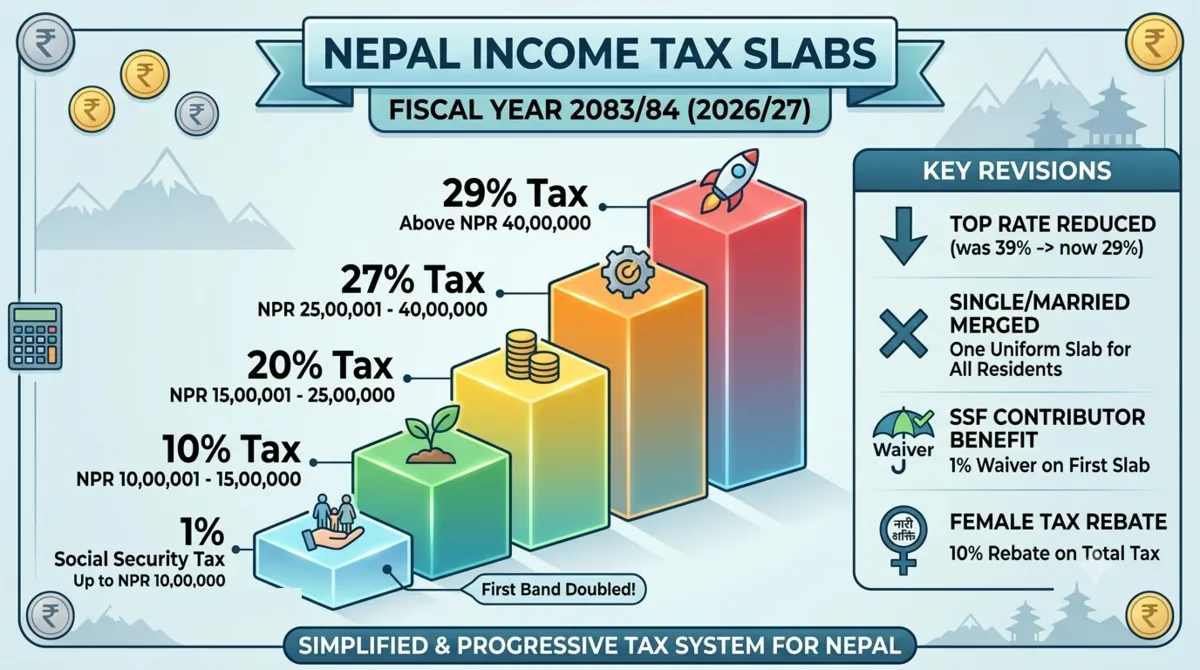
Short answerFor FY 2083/84 Nepal taxes salary in five bands: 1% on the first NPR 10,00,000, 10% to NPR 15,00,000, 20% to NPR 25,00,000, 27% to NPR 40,00,000 and 29% above that. The separate married schedule is gone, the top rate fell from 39%, and SSF contributors still skip the 1% band.
What changed in Nepal's tax slabs for FY 2083/84?
Three things moved at once: six bands became five, the 1% band doubled from NPR 5,00,000 to NPR 10,00,000, and the top rate fell from 39% to 29%. A fourth change is quieter — the separate schedule for married filers was deleted, so one table now covers everyone.
| Taxable income | FY 2082/83 (single) | FY 2083/84 (everyone) |
|---|---|---|
| First NPR 5,00,000 | 1% Social Security Tax | 1% Social Security Tax |
| 5,00,000 – 7,00,000 | 10% | 1% |
| 7,00,000 – 10,00,000 | 20% | 1% |
| 10,00,000 – 15,00,000 | 30% | 10% |
| 15,00,000 – 20,00,000 | 30% | 20% |
| 20,00,000 – 25,00,000 | 36% | 20% |
| 25,00,000 – 40,00,000 | 36% | 27% |
| 40,00,000 – 50,00,000 | 36% | 29% |
| Above 50,00,000 | 39% | 29% |
Read the middle column and the reason for the noise becomes obvious: income between NPR 5,00,000 and 10,00,000 used to be taxed at 10% and 20%. It is now inside the 1% band. That single stretch is where most salaried Nepalis live. The full band tables for all three years, single and couple, are on the tax slabs page.
How much tax does the new schedule actually save?
At a gross salary of NPR 1,00,000 a month with no retirement fund, the annual tax falls from NPR 1,45,000 to NPR 30,000 — a saving of NPR 1,15,000 a year, or about NPR 9,583 a month in hand. The saving grows with salary, because the deleted 36% and 39% bands sat at the top.
| Monthly salary | FY 2082/83 | FY 2083/84 | You keep |
|---|---|---|---|
| NPR 40,000 | 4,800 | 4,800 | +0 |
| NPR 60,000 | 29,000 | 7,200 | +21,800 |
| NPR 1,00,000 | 1,45,000 | 30,000 | +1,15,000 |
| NPR 1,50,000 | 3,25,000 | 1,20,000 | +2,05,000 |
| NPR 2,50,000 | 7,45,000 | 3,95,000 | +3,50,000 |
| NPR 4,00,000 | 13,93,000 | 8,97,000 | +4,96,000 |
The first row is not a mistake: below NPR 5,00,000 of income both years charge the same 1%, so nothing changed at the bottom of the table. The figures assume the simplest case — twelve months of salary, no PF or SSF, no insurance premium claimed — so the bands are the only thing doing the work. Add a retirement fund and both columns fall further; the gap between them stays roughly the same.
At NPR 2,50,000 a month the change is worth more than a month's salary
Do married couples still get a wider first band?
Until FY 2082/83, a married filer's first band ran to NPR 6,00,000 instead of 5,00,000. FY 2083/84 removed the couple table entirely, so marital status no longer changes the tax. Nobody pays more than last year because of it — the wider bands swallow the loss — but the old planning trick of filing as a couple is finished.
| FY 2082/83 — couple schedulefirst band ran to NPR 6,00,000 | NPR 34,000 |
|---|---|
| FY 2082/83 — single schedulewhat an unmarried colleague paid | NPR 53,000 |
| FY 2083/84 — one schedulemarried or not, the same | NPR 8,400 |
If your HR team still asks for marital status on the tax declaration form, it is now for records, not for rate selection. Any payroll system that still applies a couple table to FY 2083/84 is computing the wrong tax — worth a polite question if your TDS looks off.
Is the 1% band income tax, and who skips it?
The 1% on the first NPR 10,00,000 is the Social Security Tax, not ordinary income tax. It goes to a separate government account. If your employer contributes to the Social Security Fund, you do not pay it at all — your 11% SSF contribution already covers the same obligation. Provident Fund members still pay it.
The waiver is worth up to NPR 10,000 a year now that the band is twice as wide. It is applied automatically for SSF members in the salary tax calculator, and you can see it struck through in the band table there.
- SSF member: the 1% band is waived. Tax starts at the 10% band.
- PF member or no fund: the 1% applies to the first NPR 10,00,000 of taxable income.
- Either way: it is capped at what the band holds, so it never exceeds NPR 10,000 a year.
What did not change in FY 2083/84?
The relief ceilings are untouched: retirement contributions to PF, SSF and CIT share one limit of NPR 5,00,000 or one-third of assessable income, whichever is lower; life insurance premiums are deductible up to NPR 40,000 a year; health insurance up to NPR 20,000; and a resident woman with only employment income still gets a 10% rebate on the tax computed.
| PF + SSF + CIT, combined reliefor one-third of assessable income, whichever is lower | NPR 5,00,000 |
|---|---|
| CIT contribution, on its own | NPR 3,00,000 |
| Life insurance premium | NPR 40,000 |
| Health insurance premium | NPR 20,000 |
| Rebate for a resident womanemployment income only | 10% of the tax |
Also unchanged: tax is assessed on the year, not the month, and your employer's PF or SSF contribution counts as your income before it is relieved again. Both of those catch people out far more often than the rates do — the guide to how salary tax works walks through the order the Act applies them in, and the FAQ answers the short versions.
Which payslip do the new slabs start on?
FY 2083/84 runs from Shrawan 1, 2083 (mid-July 2026) to Ashad end, 2084. The new bands apply to income of that year — so the first payslip affected is Shrawan 2083, not the month the budget was announced. Income earned in Ashad 2083 is still taxed under FY 2082/83 rules.
A common payroll error at the year boundary
Questions people ask
What are the income tax slabs in Nepal for FY 2083/84?
Five bands apply to a resident individual's salary: 1% on the first NPR 10,00,000, 10% from 10,00,000 to 15,00,000, 20% from 15,00,000 to 25,00,000, 27% from 25,00,000 to 40,00,000, and 29% above NPR 40,00,000. The same table now applies whether you are married or not.
Is the 1% tax on the first band actually income tax?
The 1% charged on the first band is the Social Security Tax, collected with your income tax and deposited to a separate government account. Contributors to the Social Security Fund do not pay it, because their 11% SSF contribution already discharges the same obligation. Provident Fund members still pay it.
Do married couples still get a higher tax-free limit in Nepal?
No. FY 2083/84 uses one schedule for everyone. Under FY 2082/83 a married filer's first band ran to NPR 6,00,000 instead of 5,00,000, worth about NPR 19,000 a year at a salary of NPR 70,000 a month. That advantage no longer exists.
Did the top tax rate in Nepal really fall from 39% to 29%?
Yes. The 36% and 39% surcharge bands were removed and the schedule now tops out at 29% above NPR 40,00,000 of taxable income. It is the single largest change for high earners, and it is why the saving grows sharply with salary.
Sources
The law, not a summary of a summary. Where a number is disputed between sources, the statute wins.
- Income Tax Act 2058 — Inland Revenue Department
The statute the bands, reliefs and the Social Security Tax sit in. Schedule 1 carries the rate table.
- Inland Revenue Department, Nepal
The official source for the Finance Act, rate notices and the taxpayer portal.
- Social Security Fund (Samajik Suraksha Kosh)
Contribution rates and the schemes the 11% + 20% buys.
Put your own salary through it
Every figure in this post comes from the same engine that runs the calculator. Enter your monthly salary and see your own TDS, take-home and slab-by-slab working — free, and nothing leaves your browser.
Keep reading
Retirement funds
SSF vs Provident Fund: which one actually leaves you better off?
SSF takes 11% of your basic salary and PF takes 10%, so SSF looks more expensive on the payslip. Priced properly — tax waived, employer contribution, what you own at the end — the comparison usually runs the other way.
Tax planning
Six legal ways to pay less salary tax in Nepal
Every one of these is written into the Income Tax Act 2058: insurance relief, CIT room, SSF enrolment, the women's rebate, correct month counting and routing one-off pay through an approved fund. Priced, with the ceilings that limit each one.