Gross, CTC and take-home: how to read a Nepali offer letter
A CTC figure includes money that never reaches your bank account. A gross figure ignores the fund your employer pays into. Here is how to convert any Nepali offer into the two numbers that matter — cash in hand, and what you actually own.
Updated 7 min readWritten for FY 2083/84
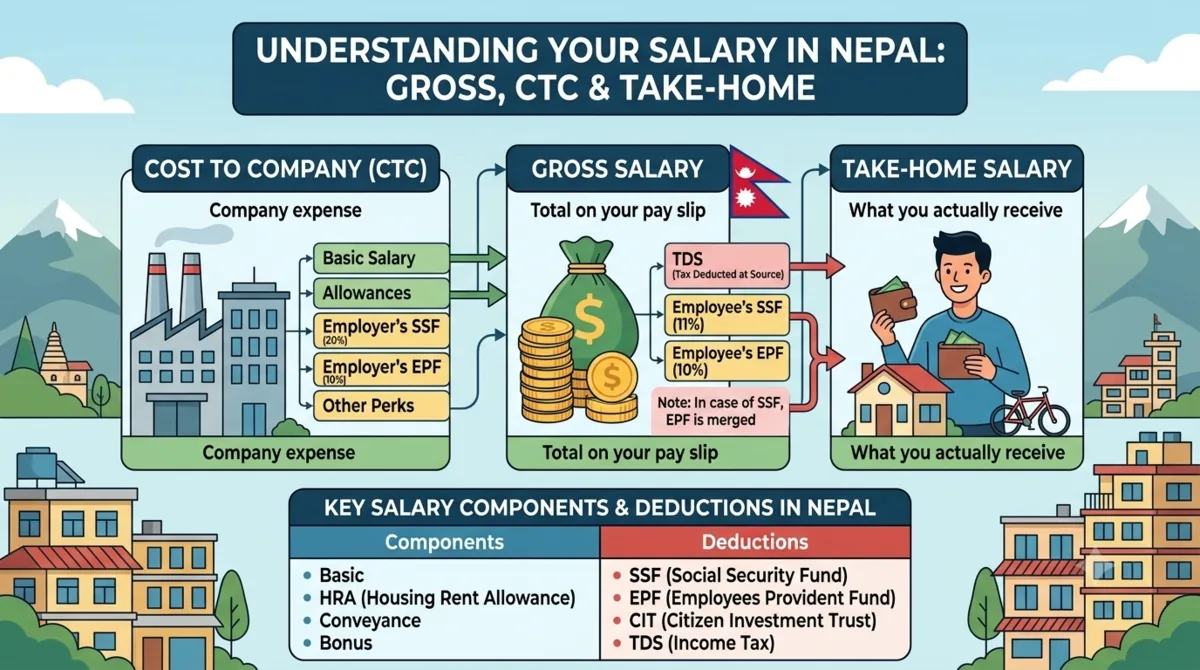
Short answerGross salary is what your employer pays you before tax and fund deductions. CTC adds the employer's PF or SSF contribution, which never reaches your account. Take-home is what is left after TDS and your own contribution. Compare offers on take-home plus your own fund balance — never on gross against CTC.
Gross, CTC or take-home — which number is real?
Gross is what the employer pays you before deductions. CTC is gross plus what the employer pays into your fund on your behalf. Take-home is what survives TDS and your own contribution. Only take-home reaches your bank account — but the fund balance is still your money, so judging an offer on take-home alone undervalues SSF-covered jobs.
| Gross salarybefore tax, before your fund contribution | Basic + grade + cash allowances |
|---|---|
| CTCincludes money that never reaches you as cash | Gross + employer fund contribution |
| Your own contributionleaves the payslip, stays your money | 10% or 11% of basic |
| Take-homewhat the bank actually receives | Gross − TDS − your contribution |
Two offers, priced properly
Offer A pays NPR 1,20,000 a month with Provident Fund and basic at 50%. Offer B pays NPR 1,10,000 with SSF and basic at 60%. A's gross is NPR 1,20,000 a year higher — but priced on take-home plus everything paid into a fund you own, offer A is ahead by only NPR 10,088, or 0.69% of the package.
| What’s compared | Offer A — 1,20,000 · PF · basic 50% | Offer B — 1,10,000 · SSF · basic 60% |
|---|---|---|
| Gross pay for the year | 14,40,000 | 13,20,000 |
| Employer fund contribution | 72,000 | 1,58,400 |
| Income tax | 46,800 | 23,288 |
| Your own contribution | 72,000 | 87,120 |
| Cash in hand | 13,21,200 | 12,09,592 |
| Added to your fund (yours + employer's) | 1,44,000 | 2,45,520 |
| Total value to you | 14,65,200 | 14,55,112 |
That is the whole lesson in one table. A nine-percent gap in gross salary — NPR 1,20,000 a year — comes out as a 0.69% difference in what you end up with, because the lower offer routes more of the package through SSF: 20% of a larger basic into an account you own, and a waived 1% band on top.
The two packages are close enough that the choice is about shape, not size. Offer A gives you NPR 1,11,608 more cash in the year. Offer B puts NPR 1,01,520more into a retirement balance you cannot spend this year, and buys the SSF medical, accident and dependant cover with it. Neither is the “better offer” in the abstract — but only one of them looks better in the letter.
Run your own two offers
How do you compare a CTC offer with a gross offer?
A CTC quote already contains the employer's fund contribution, so it is structurally larger than the salary behind it. To compare a CTC offer with a gross offer, strip the employer contribution out of the CTC first — otherwise you are comparing a package against a salary and the CTC will always look better.
Ask what the CTC includes
Employer PF or SSF, gratuity, insurance premiums, festival allowance — every component should be listed. If the employer will not itemise it, treat the figure as marketing.
Remove the employer contribution
For SSF that is 20% of basic salary, for PF 10%. Subtract it from CTC and you have the gross salary the letter should have quoted.
Check whether the festival allowance is inside it
Some employers fold one month's pay into the CTC as a thirteenth month. That is money you receive, but it arrives once a year, not monthly.
Convert to take-home
Run the gross through the calculator with the right fund and basic share. The in-hand figure is what you can plan a rent around.
Should you negotiate on gross or on take-home?
Decide on the in-hand figure you need, then work backwards to the gross that produces it and ask for that gross. Asking for “NPR 90,000 in hand” makes an employer do arithmetic they may get wrong; asking for a specific gross with a stated basic share does not.
The take-home to gross tool does exactly this conversion for FY 2083/84, including the fund you expect to be on. Take the gross it returns into the conversation, and confirm the basic share and the fund in the same sentence — those three numbers determine everything else.
What should the offer letter actually say?
Before you sign, confirm six things in writing: gross salary, basic salary as a share of gross, which retirement fund the employer contributes to, whether the festival allowance is separate or inside the quoted figure, who bears the TDS, and the probation terms.
- Gross salary per month, not CTC, not “package”.
- Basic salary as an amount or a percentage of gross.
- PF, SSF or neither — and the employer's contribution rate.
- Festival allowance — one month's basic, and when it is paid.
- TDS — deducted by the employer, with a statement you can check.
- Probation — whether the fund contributions start immediately.
With those six, any offer converts cleanly into the two numbers that decide it: what reaches your account each month, and what you own at the end of the year. Everything else in an offer letter is presentation.
Questions people ask
What is the difference between gross salary and CTC in Nepal?
Gross salary is the amount your employer pays you before tax and your own fund contribution. CTC is gross plus the employer's PF or SSF contribution and any other employer-borne cost. The employer contribution goes into your retirement fund, not your bank account, so CTC always looks larger than the salary behind it.
How do I calculate take-home salary in Nepal?
Start with gross pay for the year, add the employer's fund contribution to get assessable income, subtract the reliefs you can claim, run the rest through the FY 2083/84 bands to get the tax, then subtract the tax and your own fund contribution from gross pay. The calculator does it in one step.
Is a higher gross salary always the better offer?
No. A lower gross with SSF can beat a higher gross with no fund, because the employer adds 20% of basic salary to your own balance and the 1% Social Security Tax band is waived. Compare take-home plus your fund balance, not gross against gross.
Should I negotiate on gross or on take-home in Nepal?
Negotiate on gross, because that is what the employer controls and what appears in the letter — but decide using take-home. Work backwards from the in-hand figure you need to the gross that produces it, then ask for that gross.
Sources
The law, not a summary of a summary. Where a number is disputed between sources, the statute wins.
- Income Tax Act 2058 — Inland Revenue Department
Section 8 on employment income, and why the employer's fund contribution is assessable before it is relieved.
- Social Security Fund (Samajik Suraksha Kosh)
The 11% + 20% split that sits behind most CTC figures in Nepal.
- Labour Act 2074 (2017)
Minimum terms an offer letter has to respect, including the festival allowance.
Put your own salary through it
Every figure in this post comes from the same engine that runs the calculator. Enter your monthly salary and see your own TDS, take-home and slab-by-slab working — free, and nothing leaves your browser.
Keep reading
Retirement funds
SSF vs Provident Fund: which one actually leaves you better off?
SSF takes 11% of your basic salary and PF takes 10%, so SSF looks more expensive on the payslip. Priced properly — tax waived, employer contribution, what you own at the end — the comparison usually runs the other way.
Tax planning
Six legal ways to pay less salary tax in Nepal
Every one of these is written into the Income Tax Act 2058: insurance relief, CIT room, SSF enrolment, the women's rebate, correct month counting and routing one-off pay through an approved fund. Priced, with the ceilings that limit each one.